
Choosing between a Masai Mara safari in Kenya and a Serengeti safari in Tanzania is the single most common question travelers ask before booking their first trip to East Africa. It’s an understandable dilemma — both parks sit inside the same unbroken ecosystem, host the same wildebeest herds, and rank among the greatest wildlife destinations on the planet. Yet they deliver genuinely different experiences once you’re on the ground.
This guide breaks down the real differences in size, cost, migration timing, wildlife viewing, and overall feel, so you can decide with confidence which park — or which combination of both — fits your travel dates and budget.
| Feature | Masai Mara (Kenya) | Serengeti (Tanzania) |
|---|---|---|
| Size | 1,510 sq km | 14,760 sq km (~10x larger) |
| Great Migration presence | ~3 months (July–October) | Nearly year-round |
| River crossings | August–September peak | Northern Serengeti, July–October |
| Calving season | Not applicable | January–March, Ndutu plains |
| Crowd levels | Higher in peak season | Lower, more remote feel |
| Off-road driving | Allowed in conservancies | Not permitted |
| Typical cost | More affordable | Higher-end |
| Access | Nairobi, ~1 hr flight | Kilimanjaro/Arusha + internal flight |
| Ideal trip length | 3–5 days | 5–7+ days |
| Best suited to | First-timers, families, shorter trips | Wilderness lovers, year-round migration seekers |
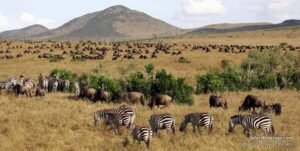
The most fundamental difference between these two safari destinations is sheer geography.
Serengeti National Park spans nearly 14,760 square kilometers, making it one of the largest protected wildlife areas on Earth. Its name comes from the Maasai word for “endless plains,” and the description is accurate — you can drive for long stretches without seeing another vehicle, giving the Serengeti an unmatched sense of wilderness and solitude.
Masai Mara National Reserve, by comparison, covers roughly 1,510 square kilometers — about a tenth the size. That smaller footprint concentrates wildlife into a tighter space, which typically means more sightings per game drive. The trade-off is that popular sightings, especially during peak migration months, can attract a cluster of vehicles.
Bottom line: choose the Serengeti for space and solitude; choose the Masai Mara for concentrated, fast-paced game viewing.
The Great Wildebeest Migration — over 1.5 million wildebeest plus hundreds of thousands of zebra — moves in a continuous loop through the Serengeti-Mara ecosystem. Here’s the detail most travelers miss: the herds spend roughly nine months of the year in Tanzania and only about three months in Kenya.
If your main goal is the iconic river crossing, the Masai Mara in August or September delivers it. If you want migration access on your own schedule with fewer crowds, the Serengeti wins by a wide margin.
Both parks offer strong Big Five safari experiences — lion, leopard, elephant, buffalo, and rhino.
Tanzania enforces strict rules in the Serengeti — off-road driving is prohibited across most of the park, keeping wildlife interactions natural and undisturbed. Kenya’s Masai Mara allows off-road driving, particularly in the private conservancies bordering the reserve, giving guides more flexibility for close sightings — though this can also mean more vehicles converging on a single sighting during peak season.
Cost is often the deciding factor, and the Masai Mara is typically 20–35% cheaper than a comparable Serengeti trip.
During peak season, the Masai Mara’s main reserve can see significant vehicle congestion at popular sightings. The Serengeti’s scale generally allows for more solitude, even in busy months.
The Mara’s private conservancies — such as Naboisho, Mara North, and Olare Motorogi — solve much of this. They cap vehicle numbers, allow off-road driving, and offer night drives and guided walking safaris, none of which are permitted inside the Serengeti National Park itself.
Yes — and for travelers with 10–14 days, combining a Kenya and Tanzania safari is one of the best ways to experience the full Serengeti-Mara ecosystem, pairing the Mara’s wildlife density with the Serengeti’s scale and the Ngorongoro Crater’s rhino sightings.
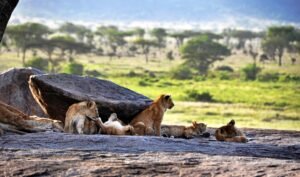
Choose the Masai Mara if you want: concentrated wildlife sightings, a shorter and more affordable trip, easy access from Nairobi, the classic river crossing experience, or a family-friendly safari with night drives.
Choose the Serengeti if you want: vast, remote wilderness, year-round migration access, the extraordinary calving season, a full northern Tanzania circuit, and stricter conservation standards.
Have the time? Combining both parks remains the single best way to experience everything the Serengeti-Mara ecosystem has to offer.
What’s the main difference between the Masai Mara and the Serengeti?
The Masai Mara is a compact Kenyan reserve (1,510 sq km) known for concentrated wildlife and affordability. The Serengeti is a vast Tanzanian park (14,760 sq km) offering year-round migration access and a premium, remote wilderness experience.
Which is better for the Great Migration?
The Serengeti hosts the migration for about nine months a year, including calving season. The Masai Mara hosts it for roughly three months, centered on the July–October river crossings.
Is the Masai Mara cheaper than the Serengeti?
Yes, typically 20–35% cheaper for a comparable safari, due to lower park fees and a wider range of accommodation options.
Which park is better for first-time safari-goers?
Most first-timers do well with the Masai Mara thanks to easy access, high wildlife density, and shorter trip requirements. Experienced travelers often prefer the Serengeti’s scale and the northern Tanzania circuit.
How many days should I plan for each park?
3–5 days for the Masai Mara; 5–7+ days for the Serengeti, especially when combined with Ngorongoro Crater, Tarangire, and Lake Manyara.
Are the Masai Mara and Serengeti part of the same ecosystem?
Yes — there’s no fence between them, and the migration herds move freely across the unfenced Kenya–Tanzania border as part of one continuous ecosystem covering over 30,000 sq km.
