Planning a trip to one of Africa’s most iconic wilderness areas deserves more than a quick Google search. This Serengeti private safari guide covers everything — the best zones, the Great Migration calendar, exclusive camp selection, and private game drive strategies — so that when you arrive, you arrive informed, excited, and ready for one of the great wildlife Destination on the planet.
The Serengeti is vast, complex, and deeply rewarding when navigated well. At nearly 15,000 square kilometres, choosing the wrong zone at the wrong time of year can mean missing the very thing you came for. That is precisely why Glitzy Safaris has put together this complete guide — drawing on years of on-the-ground experience across every corner of the park and every season — to help you plan a Serengeti private safari that exceeds every expectation you arrived with.
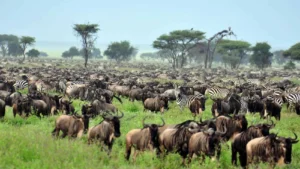
The Serengeti receives a significant number of visitors each year, and during peak migration season, the most famous crossing points can attract multiple vehicles simultaneously. Understanding this is important — not because it diminishes the experience, but because it explains precisely why a Serengeti private game drive makes such a profound difference to what you actually encounter and how you encounter it.
On a private safari, your guide is not managing the expectations of six different people with six different interests. Instead, every decision — where to drive, how long to stay, which areas to prioritise — is made entirely around you. When a leopard drops a kill from a tree and the action unfolds over forty-five minutes, you stay for every second of it. When the light hits a kopje in a way that takes your breath away, you stop and simply sit with it.
Furthermore, an exclusive safari Serengeti experience gives your guide the freedom to take routes that shared vehicles cannot justify. Private tracks, less-visited zones, early morning departures before the park roads are busy — these are the privileges of a private game drive, and they translate directly into better sightings, deeper experiences, and memories that are genuinely your own.
Glitzy Safaris designs every Serengeti itinerary as a fully private experience. From the vehicle to the guide to the camp, nothing is shared unless you choose it to be.
One of the most telling things about the Serengeti is how many people return. Guests who visit once with Glitzy Safaris very often come back — sometimes within a year, sometimes to a different zone, sometimes in a different season. The reason is simple: the Serengeti is not a single experience. It is a living, constantly shifting ecosystem that offers something entirely different depending on when you go, where you stay, and what the land is doing at that particular moment. A January calving season in the south bears almost no resemblance to an August river crossing in the north — yet both are extraordinary in their own right.
Before choosing where to stay and when to visit, it helps to understand the basic geography of the Serengeti. At nearly 15,000 square kilometres, the park is enormous — roughly the size of Northern Ireland. Consequently, location matters enormously when planning a Serengeti National Park private safari guide itinerary.
The Seronera Valley sits at the heart of the Serengeti and is the most consistently productive zone for wildlife year-round. The Seronera River system runs through this area, attracting resident populations of lion, leopard, elephant, buffalo, giraffe, and a remarkable diversity of bird species. Because water is always available here, animals do not follow the migration out of this zone — they stay, which means reliable sightings regardless of when you visit.
For first-time Serengeti visitors, Seronera is often the ideal base. The concentration of resident predators is particularly impressive, and the fig trees along the riverbanks are among the best leopard-spotting locations in all of Africa. A Serengeti private game drive through the Seronera Valley at dawn, with an experienced Glitzy Safaris guide reading the landscape, is one of the finest wildlife experiences the continent offers.
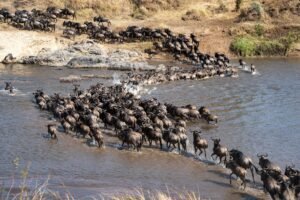
The northern Serengeti is where the Great Migration reaches its most dramatic peak. Between July and October, millions of wildebeest, zebra, and gazelle push north from the central plains toward the Mara River, which forms the boundary between Tanzania and Kenya. The river crossings — where massive herds throw themselves into crocodile-filled water in a collective act of instinct over reason — are among the most extraordinary wildlife spectacles on earth.
For the best zones Serengeti private safari experience during migration season, the northern Serengeti is simply unmatched. The Lamai Wedge specifically sits between two river systems and sees crossings on both sides, making it the most strategically positioned area for witnessing the migration at its most intense. Glitzy Safaris works with a small selection of exclusive camps in this zone — camps with very limited guest numbers and private vehicles — so that migration sightings feel intimate rather than crowded.
Beyond the crossings, the northern Serengeti has exceptional resident wildlife. Lion prides here are large and frequently sighted. Cheetah are common on the open plains. Elephant move through in substantial herds. Even outside of migration season, the northern corridor delivers outstanding game viewing for guests on an exclusive safari Serengeti itinerary.
The southern Serengeti transforms between December and March into one of the most extraordinary wildlife spectacles in the world — one that is almost entirely separate from the river crossings in the north. This is calving season. Roughly half a million wildebeest calves are born within a matter of weeks on the short grass plains around Ndutu, creating a concentration of newborn life that attracts every predator in the ecosystem.
Lion, cheetah, leopard, hyena, wild dog, and jackal all converge on the southern plains during calving season. The hunting is intense, the action is constant, and the emotional complexity of watching new life and predation unfold simultaneously is something that stays with guests long after they return home. For a Serengeti National Park private safari guide itinerary focused on predator activity, January to March in the south is arguably the single most dramatic period in the entire park calendar.
Additionally, the southern plains and Ndutu area are notably less visited than the central and northern zones during this period, which makes a Serengeti private game drive here feel genuinely exclusive — vast open landscapes with very few other vehicles in sight.
The western corridor of the Serengeti is where the migration passes through between May and July on its northward journey. The Grumeti River — shallower and narrower than the Mara but equally full of enormous crocodiles — provides its own crossing drama during this period. However, the western Serengeti is far less visited than the north, meaning the crossings here are witnessed by a fraction of the guests who crowd the Mara River banks later in the season.
For travellers seeking an exclusive safari Serengeti experience with genuine remoteness, the western corridor in June is a compelling option. Glitzy Safaris can arrange private camp access in this zone for guests who want the migration experience without the relative concentration of vehicles that the northern Serengeti attracts at peak season.
No Serengeti National Park private safari guide is complete without a thorough explanation of the Great Migration — the largest overland movement of mammals on earth and the event most visitors are hoping to witness when they book a Serengeti safari.
Approximately 1.5 million wildebeest, 400,000 zebra, and 300,000 Thomson’s gazelle move in a continuous, clockwise circuit around the Serengeti-Mara ecosystem throughout the year. They follow the rains and the fresh grass those rains produce, moving south, then west, then north, then back south again in an annual cycle that has continued for millennia.
The migration is not a single event — it is a year-round process, and there is genuinely no bad time to see it. Rather, different times of year offer different aspects of the same extraordinary phenomenon.
January to March — Calving Season, Southern Serengeti The short grass plains around Ndutu explode with newborn wildebeest. Predator activity reaches its annual peak. The landscape is green, lush, and visually stunning. This is one of the most underrated periods for a Serengeti private game drive and one that Glitzy Safaris strongly recommends for guests who want predator action over river crossings.
April to May — The Long Rains The herds begin moving northwest as the long rains arrive. This is low season — fewer visitors, lower rates, and a Serengeti that is dramatically green and alive with birdlife. Game viewing remains excellent, and the sense of having the park to yourself is very real.
June to July — Western Corridor and Grumeti Crossings The migration reaches the Grumeti River. Crocodile crossings begin. The western corridor is at its most productive, and the relative absence of other vehicles makes this one of the best periods for an exclusive safari Serengeti experience.
July to October — Northern Serengeti and Mara River Crossings This is the period most people associate with the Great Migration. The Mara River crossings in the northern Serengeti are dramatic, unpredictable, and emotionally overwhelming in the best possible way. Glitzy Safaris positions guests in private camps within the Lamai Wedge for maximum exposure to crossing activity while maintaining the intimacy of a private experience.
November to December — The Return South The short rains arrive and the herds begin moving south again. The landscape transforms back to green. This transitional period is beautiful, relatively uncrowded, and often underestimated by first-time visitors.
The Great Migration is the headline act, but the Serengeti’s permanent resident wildlife is extraordinary in its own right and deserves equal attention in any honest Serengeti National Park private safari guide.
The Serengeti has one of the highest lion densities in Africa. Prides here are large — some numbering over twenty individuals — and lions are sighted on virtually every game drive in every season. The Seronera Valley is particularly rich in resident prides, and the open plains make viewing and photography especially rewarding.
Leopard are present throughout the park but are most reliably sighted in the Seronera River area, where the dense fig trees provide perfect cover and elevated resting spots. A dawn Serengeti private game drive along the Seronera River, specifically looking for leopard, is one of the most exciting and focused wildlife experiences Glitzy Safaris offers.
Cheetah thrive on the open short grass plains of the southern and eastern Serengeti. Unlike leopard, cheetah are diurnal — they hunt during daylight hours — making them one of the most accessible big cats to observe in action. Watching a cheetah hunt at full speed across the open plain is one of those Serengeti moments that simply cannot be replicated anywhere else.
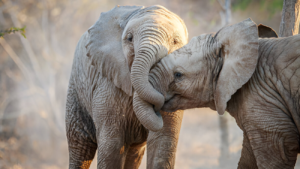
Large elephant herds move through the Serengeti year-round, particularly in the western corridor and around the boundary with the Ngorongoro Conservation Area. Buffalo herds in the Seronera area are enormous — sometimes numbering in the thousands — and attract large lion prides that specialise in hunting them.
Black rhino, the fifth member of the Big Five, is present in the Serengeti but in very small numbers and rarely sighted within the main park. For reliable rhino viewing, the Ngorongoro Crater — which Glitzy Safaris frequently combines with a Serengeti itinerary — offers far better odds.
African wild dog is one of the most endangered carnivores on the continent and one of the most electrifying animals to observe on a Serengeti private game drive. Packs move over enormous ranges, and sightings are never guaranteed — which is precisely why they are so celebrated when they occur. Glitzy Safaris guides maintain active communication with other field teams across the park to maximise wild dog sighting opportunities for guests.
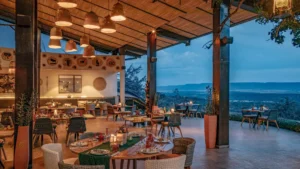
Where you sleep in the Serengeti matters as much as where you drive. The park has a wide range of accommodation — from large lodges with dozens of rooms to intimate private camps with as few as four tents. For a genuinely exclusive safari Serengeti experience, Glitzy Safaris exclusively partners with small, private camps that share our values around wildlife, sustainability, and guest experience.
Location relative to your target zone. A camp in the north cannot efficiently reach the southern calving grounds and vice versa. Glitzy Safaris matches camp location to the time of year and the specific experiences each guest is seeking — this is one of the most important planning decisions we make on your behalf.
Guest numbers. The best private camps in the Serengeti host between four and twelve guests at most. Fewer guests means quieter game drives, more personalised guiding, and an atmosphere of genuine exclusivity that larger lodges simply cannot replicate.
Private vehicles. Some camps share vehicles between guests. For a true Serengeti private game drive experience, your camp should assign a dedicated vehicle and guide to your party alone. Glitzy Safaris confirms this for every camp in our portfolio.
Sustainability credentials. The Serengeti’s integrity depends on responsible tourism. Glitzy Safaris works exclusively with camps that operate with genuine low-impact principles — solar power, minimal footprint, community involvement, and active support for conservation.
There is no bad time to visit the Serengeti — but there is a best time for each type of experience. Understanding this helps Glitzy Safaris build an itinerary that is perfectly matched to what you actually want to see and feel.
For the river crossings: July to October in the northern Serengeti. Book twelve to eighteen months in advance for the best camp availability.
For predator and calving action: January to March in the southern Serengeti. Excellent value, fewer visitors, and some of the most intense wildlife drama in the park calendar.
For exclusivity and value: April to June and November. Low season brings dramatically reduced rates, genuinely empty roads, and a green, birdlife-rich landscape that experienced safari-goers love.
For year-round resident wildlife: The central Seronera Valley delivers in every month of the year without exception.
Getting there. Most guests fly into Kilimanjaro International Airport or Julius Nyerere International Airport in Dar es Salaam, then connect to one of the Serengeti’s several airstrips via scheduled or charter flight. Glitzy Safaris handles all logistics — ground transfers, domestic flights, and airstrip meet-and-greet — as part of every itinerary.
Park fees. Tanzania National Parks (TANAPA) charges conservation fees for the Serengeti, currently among the highest in Africa. These fees are included in all Glitzy Safaris itinerary costings and support the park’s ongoing conservation work.
Health and vaccinations. Yellow fever vaccination is required for entry into Tanzania if arriving from certain countries. Malaria prophylaxis is strongly recommended for the Serengeti. Glitzy Safaris provides a full health and vaccination briefing to every guest during the planning process.
Photography. The Serengeti is one of the world’s great photography destinations. A good telephoto lens — 300mm or longer — makes an enormous difference to wildlife photography from a vehicle. Glitzy Safaris can advise on photography-specific game drive strategies for guests with a serious interest in wildlife photography.
Planning a Serengeti safari well requires more than reading a guide online — it requires someone who knows which camp faces east for the best sunrise views, which guide has the deepest knowledge of cheetah territories in the southern plains, and which weeks in July see the most reliable Mara River crossing activity. It requires someone who has been there, repeatedly, across every season.
That is Glitzy Safaris. We are a Tanzania-based team with deep, current knowledge of every zone, camp, and seasonal dynamic in the Serengeti. Every Serengeti National Park private safari guide itinerary we build is tailored entirely to the individual guest — your interests, your travel style, your budget, and the specific experiences that matter most to you. We do not sell fixed packages. We build bespoke journeys, and we back them with the kind of on-the-ground support that only a local operator can genuinely provide.
The Serengeti will exceed your expectations — that is simply what it does. However, the difference between a good Serengeti safari and a truly extraordinary one comes down to preparation, local knowledge, and the freedom that only a private experience provides. The right zone at the right time of year. The right camp in the right location. A guide who reads the landscape like a language and takes you places that shared vehicles never reach.
A Serengeti National Park private safari with Glitzy Safaris gives you all of that. The wild is waiting, and it is more extraordinary than you can currently imagine.
Ready to plan your Serengeti private safari? Contact Glitzy Safaris today and let us build your perfect itinerary from the ground up.