Planning a Tanzania safari often starts with the Serengeti and Ngorongoro Crater. Yet seasoned guides and experienced travellers keep returning to one destination above all others — a Tarangire private safari. Not only does the park offer fewer crowds, but it also delivers ancient baobab landscapes and the largest elephant herds in Africa. As a result, Tarangire has become one of East Africa’s most rewarding wildlife experiences. This guide covers everything you need to know: the best time to visit Tarangire, what wildlife to expect, how it compares in a Tarangire vs Serengeti private safari, and why the elephants alone are worth the journey.
Tarangire National Park one of the best Tanzania Destination covers roughly 2,850 square kilometres in northern Tanzania. It sits between Lake Manyara and the Serengeti ecosystem, and because it lies slightly off the main tourist circuit, it attracts far fewer visitors than its famous neighbours. Consequently, a Tarangire private safari delivers something increasingly rare in East Africa: extraordinary wildlife alongside genuine solitude, often with no other vehicles in sight.
Experienced travellers — those who have already visited the Serengeti twice — consistently say Tarangire surprised them most. In fact, many return specifically for the park rather than as part of a broader circuit.
Everything in Tarangire revolves around its river. During the dry season, the Tarangire River is the only permanent water source in the area. As a result, between June and October it acts as a powerful magnet, pulling wildlife from hundreds of kilometres around.
Elephant, buffalo, zebra, wildebeest, giraffe, lion, leopard, cheetah, wild dog, and over 550 recorded bird species all converge on the river corridor. Furthermore, because the park is less visited, those sightings often unfold with no other vehicle present — a genuinely rare luxury in modern safari travel.
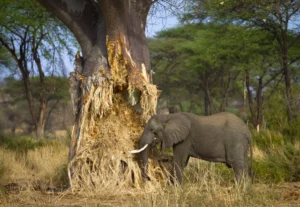
The elephants of Tarangire are the park’s defining feature. Between 3,000 and 4,000 elephants move through the ecosystem, with dry-season concentrations that can exceed 300 animals in a single herd. To put that in perspective, seeing 300 elephants together is not a normal safari experience. In Tarangire, however, it is simply what July looks like.
Beyond sheer numbers, Tarangire’s elephants carry themselves differently. They are relaxed, unhurried, and deeply comfortable around vehicles. As a result, close approaches that would be unusual elsewhere are entirely normal here. Bull elephants, matriarchs with newborn calves, and teenage males testing their strength — the full social complexity of elephant life plays out in front of you. Moreover, Glitzy Safaris guides can identify individual animals, explain family dynamics, and translate subtle communication passing between herd members.
Tarangire is one of the best places in Africa to watch elephant calves. Because herds are large and relaxed, calves are frequently visible at close range — nursing, playing, getting stuck in riverside mud, and being fussed over by aunts and older siblings. Consequently, a morning spent watching a family herd interact at the river is the kind of experience that stays with you long after every other detail has faded. For that reason, Glitzy Safaris builds dedicated elephant time into every Tarangire itinerary.
If elephants are Tarangire’s most famous residents, then the baobab trees are its most unforgettable backdrop. Some are over 1,000 years old, with swollen trunks that dwarf everything else in the landscape. Moving through this baobab woodland on a Tarangire private safari feels like travelling through a landscape from another era. Additionally, photographers, artists, and writers have been attempting to capture them for generations — most agree that no image fully does them justice.
The combination of ancient baobab trees and enormous elephant herds creates a visual drama unique to Tarangire. Elephants lean against baobab trunks to scratch their shoulders and strip bark during dry season to access stored moisture. Meanwhile, a family herd moving between baobabs at golden hour — warm light, long shadows — produces one of the most beautiful wildlife scenes in Africa. Glitzy Safaris positions every guest to witness exactly this.
Tarangire’s permanent swamps, including Silale and Gursi, stay wet even at the height of dry season. As a result, python, elephant, buffalo, and a wide variety of waterbirds gather around their margins. An early-morning swamp drive adds a dimension to the Tarangire private safari that most guests do not anticipate. For this reason, Glitzy Safaris includes swamp game drives in every itinerary as standard.
Tarangire’s predator population is significantly underappreciated relative to the Serengeti. Lion prides are resident throughout the park and particularly active along the river corridor. Leopard are regularly sighted in the acacia woodland. Additionally, cheetah hunt on open floodplains during dry season.
Crucially, Tarangire is one of Tanzania’s most reliable parks for African wild dog sightings. Several packs are resident in the ecosystem and regularly encountered on a Tarangire private safari during dry season. Watching a whole pack move at speed through acacia scrub in pursuit of impala is, without doubt, one of the most electrifying wildlife experiences in Africa.
Between November and April, large herds of wildebeest and zebra migrate into Tarangire from the Maasai steppe, drawn by fresh rains and new grass. This movement brings migration drama to the park on a smaller, more intimate scale. Importantly, it arrives without the crowds that the Serengeti migration attracts. For guests visiting during the green season, therefore, this influx adds a completely different dimension to the overall experience.
With over 550 recorded species, Tarangire ranks among the finest birding destinations in East Africa. The park is particularly celebrated for its dry-season raptor concentrations, its resident yellow-collared lovebird and Rueppell’s starling, and its remarkable variety of migratory species during the wet season. Even guests who arrive with no particular interest in birds typically leave having developed one.
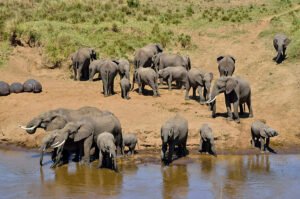
The dry season is the best time to visit Tarangire for wildlife viewing, and especially for a Tarangire elephant safari. As water sources dry up across the surrounding landscape, animals concentrate along the river in increasingly dramatic numbers. By August, riverbanks are lined with elephant families, buffalo herds, and zebra. Predators follow the grazers. Furthermore, vegetation dries back, visibility improves, and roads are in their best condition.
Rain transforms Tarangire almost overnight. The landscape turns vivid green, migratory wildebeest and zebra flood in from the Maasai steppe, and baby animals appear everywhere — elephant calves, impala fawns, and zebra foals. Meanwhile, birdlife peaks as migratory species arrive from Europe and Asia.
Visitor numbers drop significantly during this period. As a result, rates are more competitive and the sense of having the park to yourself becomes very real. For guests who want a Tarangire private safari that feels genuinely remote, the green season is therefore an excellent and underrated choice.
May and November sit between the main seasons and offer a compelling combination of solid wildlife viewing, low visitor numbers, and competitive rates. Glitzy Safaris often recommends these months for guests combining Tarangire with the Serengeti or Ngorongoro Crater — particularly those seeking quality without peak-season pricing.
This is one of the most common questions guests ask when planning a Tanzania itinerary. The honest answer is that they are not in competition — they offer fundamentally different experiences, and the best itineraries include both.
The Serengeti offers the Great Migration — the largest overland movement of mammals on earth. For migration specifically, therefore, the Serengeti wins. For elephants, however, Tarangire wins comprehensively. No destination in Tanzania matches Tarangire for elephant volume, accessibility, and the quality of encounters during dry season. In addition, wild dog sightings are significantly more reliable here than in the Serengeti.
The Serengeti’s most famous areas attract multiple vehicles simultaneously during peak season, even on private game drives. A Tarangire private safari during dry season, by contrast, delivers extraordinary wildlife on roads that are largely empty. That combination — quality sightings alongside genuine solitude — is increasingly rare and increasingly valuable in modern safari travel.
The Serengeti’s open plains are vast, dramatic, and humbling in their scale. Tarangire’s baobab woodland, on the other hand, is intimate, ancient, and visually extraordinary in a completely different way. Both landscapes are memorable. Nevertheless, neither replaces the other.
Combine them. Two to three nights in Tarangire, followed by the Serengeti, gives you the best of both worlds. Tarangire builds bush confidence and delivers extraordinary elephant encounters. The Serengeti then adds scale, migration drama, and the iconic open plain experience. Together, they form a Tanzania itinerary that covers every dimension of what makes this country the finest safari destination on earth.
Camps inside Tarangire National Park offer the most immersive experience available. Wildlife moves freely through and around these properties. Elephants visit camp at night, and lions call from nearby. Furthermore, Glitzy Safaris partners exclusively with small camps of between four and ten tents, with private vehicles and guides who know the ecosystem deeply. These camps also allow the earliest departures for morning game drives — giving guests the first vehicle on the river road each day.
Several conservation areas bordering Tarangire are accessible only to guests of specific camps. These areas offer a Tarangire private safari with even greater exclusivity — no park fees, no other vehicles, and wildlife that includes all species found in the main park. Glitzy Safaris recommends these areas particularly for guests seeking the maximum sense of wilderness combined with exceptional guiding.
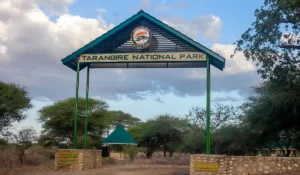
What makes Tarangire famous? Tarangire is famous above all for its elephants. The park hosts one of the largest elephant populations in Africa, with dry-season herds that can exceed 300 animals. Additionally, its ancient baobab trees create a landscape unlike anywhere else in Tanzania.
What is the best time to visit Tarangire? July and August offer the most dramatic wildlife concentration along the Tarangire River. However, November to February is excellent for green season photography, baby animals, and birdlife. Ultimately, the best time to visit Tarangire depends on what you most want to see — Glitzy Safaris helps every guest match their dates to their priorities.
How does a Tarangire private safari compare to the Serengeti? In a Tarangire vs Serengeti private safari comparison, Tarangire wins on elephants, solitude, and wild dog sightings. The Serengeti, meanwhile, wins on migration scale and iconic open plains. The best itineraries, therefore, include both.
Is Tarangire good for a first safari? Absolutely. Tarangire is one of our top recommendations for first-time guests. Wildlife is abundant and approachable, visitor numbers are low, and the elephant encounters alone create a profound first impression.
How far is Tarangire from the Serengeti? Tarangire sits roughly 2.5 to 3 hours by road from the Serengeti’s southern entrance. Most Glitzy Safaris guests, however, travel between parks by light aircraft, which reduces the journey to around 45 minutes.
Can you do a day trip to Tarangire from Arusha? Technically yes — Tarangire is about two hours from Arusha. Nevertheless, we strongly recommend a minimum of two nights. A day trip gives you one game drive. Two nights, on the other hand, gives you four game drives, river walks, and the time needed to properly absorb one of Tanzania’s most extraordinary landscapes.
How does a private safari differ from a group tour? On a group tour, you share a vehicle, follow a fixed schedule, and stop when the majority agrees. On a Tarangire private safari with Glitzy Safaris, however, every decision is made around you. When 200 elephants arrive at the river, you stay until you are ready to leave. That freedom is transformative.
Does Glitzy Safaris combine Tarangire with other parks? Always. A standalone Tarangire trip is wonderful, but we almost always recommend combining it with the Serengeti and Ngorongoro Crater for a complete northern Tanzania circuit. As a result, we handle all logistics — flights, transfers, camp bookings, and permits — so every transition is seamless.
Tarangire is the park that surprises people. Guests arrive expecting a warm-up before the Serengeti and, instead, leave wondering why they did not stay longer. The elephants exceed anything they imagined. The baobabs exceed anything they have seen. Moreover, the silence — the rare, genuine silence of a park with almost no other vehicles — is something they did not know they needed until they had it.
A Tarangire private safari with Glitzy Safaris gives you access to all of that. Ready to plan yours? Contact Glitzy Safaris today and let us put Africa’s greatest elephant destination at the heart of your Tanzania experience.