If you have ever dreamed of watching a million wildebeest thunder across the Serengeti plains, you already understand why the Great Migration is considered the greatest wildlife spectacle on Earth. However, witnessing it properly — at the right place, at the right moment — requires more than simply booking a flight to Tanzania. It requires a well-planned Great Migration private safari itinerary Tanzania that puts you exactly where the action is, precisely when it happens.
At Glitzy Safaris, we have spent years studying the migration’s patterns, the river crossing hotspots, and the seasonal movements that determine where a million animals will be on any given month. This guide shares everything we know — so your safari delivers the experience you came for.
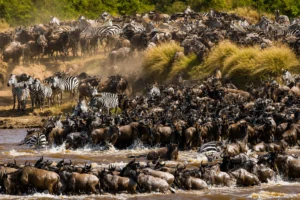
Before diving into the itinerary, it helps to understand what you are actually chasing. The Great Migration is the continuous, year-round circular movement of approximately 1.5 million wildebeest, 300,000 zebras, and 500,000 gazelles across the Serengeti-Mara ecosystem — covering Tanzania and Kenya in an endless search for fresh grass and water.
Furthermore, this is not a single event you can book like a concert ticket. The migration is a living, unpredictable phenomenon that shifts with rainfall patterns, grass growth, and the instincts of millions of animals. Therefore, knowing the monthly pattern is everything.
The most dramatic moments include:
A wildebeest migration private tour gives you something a group safari simply cannot — the ability to move. The migration does not follow a fixed schedule. River crossings can happen at dawn, midday, or not at all on a given day. Herds can shift overnight based on rainfall fifty kilometres away.
Because your vehicle and guide are exclusively yours on a Glitzy Safaris private tour, you can:
Moreover, private safaris allow you to be at the Mara River bank before sunrise — when the light is extraordinary and the crossing probability is highest. Group tours rarely offer that level of positioning. Consequently, private guests consistently report better sightings than those on shared vehicles.
Understanding the monthly calendar is the foundation of any successful migration safari route Tanzania. Here is exactly where to be and when throughout the year.
| Month | Location | What to Expect |
|---|---|---|
| January – February | Southern Serengeti | Calving season — thousands of newborn wildebeest |
| March – April | Central Serengeti | Herds moving north, predator activity very high |
| May | Central to Western Serengeti | Long rains begin, herds gathering in western corridor |
| June | Western Serengeti corridor | First river crossings of the Grumeti River |
| July – August | Northern Serengeti & Masai Mara | Peak Mara River crossings — the iconic spectacle |
| September – October | Northern Serengeti | Continued crossings, herds beginning return south |
| November – December | Eastern Serengeti | Herds moving south, short rains arrive |
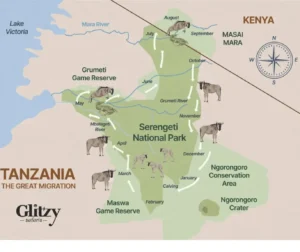
From January through February, the southern Serengeti short-grass plains around Ndutu are the place to be. This is calving season — the period when approximately 500,000 wildebeest calves are born within a six-week window. Because so many vulnerable newborns are present simultaneously, predator activity during this period is among the most intense anywhere in Africa.
Lions hunt in coordinated prides. Cheetahs single out weakened calves on the open plains. Hyena clans are active around the clock. Additionally, the short-grass plains provide extraordinary visibility — you can see for kilometres in every direction, making wildlife spotting exceptionally productive.
A Great Migration private safari itinerary Tanzania built around January and February delivers some of the most dramatic predator-prey interactions on the continent. Furthermore, the southern Serengeti receives fewer visitors than the northern crossing sites, making the experience feel genuinely wild and uncrowded.
Best camps for calving season: Ndutu area camps, southern Serengeti mobile camps
By June, the herds have moved northwest into the western Serengeti corridor. Here, the Grumeti River presents the first major obstacle of the migration year. Unlike the famous Mara crossings, the Grumeti tends to be less visited — which makes a wildebeest migration private tour to this zone a genuinely special experience.
The Grumeti River is home to some of the largest Nile crocodiles in Africa. These massive reptiles have waited all year for this moment, and the crossings that occur here are explosive and raw. Because the western corridor attracts fewer tourists than the north, your experience at the riverbank feels exclusive and undisturbed.
Additionally, the western corridor in June offers outstanding general game viewing alongside the migration — elephant herds, buffalo, topi, and large lion prides all concentrate in this zone.
Best camps for Grumeti crossings: Western corridor permanent and seasonal camps
This is the moment most people picture when they imagine the Great Migration. From July through October, the herds reach the northern Serengeti and face the Mara River — the most dramatic crossing point in the entire migration safari route Tanzania.
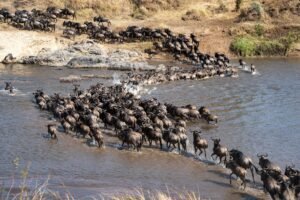
A Mara River crossing private safari is, without question, the most exhilarating wildlife experience available anywhere on Earth. Thousands of wildebeest gather on the riverbank. The tension builds for hours as the herd edges forward and retreats. Then, suddenly, one animal commits — and the entire herd follows in a thundering, chaotic, unstoppable wave.
Crocodiles surge from the water. Lions wait on the far bank. The noise, the dust, the sheer scale of the moment is overwhelming. Furthermore, crossings can happen multiple times per day at different points along the river, meaning a private vehicle can reposition between sites to maximize the chances of witnessing multiple events.
Because crossings are unpredictable, spending a minimum of three nights in the northern Serengeti is strongly recommended. Consequently, your Mara River crossing private safari itinerary should build in flexibility — the ability to stay an extra day if a crossing is imminent is one of the most valuable things a private safari offers.
Best camps for Mara crossings: Northern Serengeti camps along the Mara River — Lamai, Kogatende, and Wogakuria areas
The central Serengeti around Seronera is the year-round heart of the ecosystem. Even outside peak migration months, this zone delivers exceptional game viewing. The Seronera River supports large resident populations of lion, leopard, and cheetah regardless of season.
Therefore, a well-structured Great Migration private safari itinerary Tanzania always includes at least one night in the central Serengeti — both as a transit point between zones and as a destination in its own right. The leopard sightings along the Seronera River are among the most reliable in Africa.
This is the Mara River crossing private safari itinerary that Glitzy Safaris recommends most highly for travelers visiting during peak crossing season.
| Day | Location | Focus |
|---|---|---|
| Day 1 | Arusha → Tarangire | Arrival game drive, elephants |
| Day 2 | Tarangire → Central Serengeti | Transit, afternoon game drive |
| Day 3 | Central Serengeti | Seronera predators, leopard search |
| Day 4 | Central → Northern Serengeti | Migration herds, river positioning |
| Day 5 | Northern Serengeti | Full day Mara River crossing vigil |
| Day 6 | Northern Serengeti | Second crossing opportunity, flexibility day |
| Day 7 | Northern Serengeti → Arusha | Morning game drive, departure |
| Day | Location | Focus |
|---|---|---|
| Day 1 | Arusha → Ngorongoro Crater | Big Five crater game drive |
| Day 2 | Ngorongoro → Southern Serengeti | Arrival at Ndutu plains |
| Day 3 | Southern Serengeti — Ndutu | Calving herds, cheetah and lion hunts |
| Day 4 | Southern Serengeti — Ndutu | Full day predator and newborn activity |
| Day 5 | Central Serengeti | Seronera leopards, resident wildlife |
| Day 6 | Central Serengeti → Arusha | Morning game drive, departure |
Most travelers who witness a Mara River crossing describe it as the single most powerful wildlife experience of their lives. Nevertheless, the difference between a mediocre crossing experience and an extraordinary one comes entirely down to logistics.
Here is what separates a Mara River crossing private safari with Glitzy Safaris from a standard group tour:
| Factor | Private Safari | Group Tour |
|---|---|---|
| Vehicle positioning | Best riverbank spot, arrive early | Shared position, late arrival common |
| Time at the river | Stay as long as needed | Fixed schedule, limited time |
| Multiple crossings | Reposition between sites freely | Fixed to one location |
| Guide intelligence | Real-time updates from guide network | General itinerary followed |
| Group pressure | Zero — your group only | Always present |
Choosing the right camp location is as important as choosing the right month. Because the migration moves continuously, mobile camps that reposition seasonally are often the best option for serious migration followers.
| Zone | Season | Camp Type |
|---|---|---|
| Southern Serengeti — Ndutu | January – March | Seasonal mobile camps |
| Western Corridor | June | Permanent and mobile camps |
| Northern Serengeti | July – October | Permanent river camps |
| Central Serengeti | Year-round | Permanent lodges |
Glitzy Safaris works with a carefully selected portfolio of camps across all migration zones — from intimate mobile tented camps that move with the herds to exclusive permanent lodges with private river frontage.
The cost of a wildebeest migration private tour varies significantly depending on season, camp level, and duration. Peak season camps in the northern Serengeti during July to October command premium rates due to high demand.
| Safari Level | Estimated Cost Per Person (7 days) | Notes |
|---|---|---|
| Mid-Range | $4,000 – $6,000 | Comfortable camps, shared facilities |
| Luxury | $7,000 – $12,000 | Exclusive camps, private locations |
| Ultra-Luxury | $12,000+ | Private conservancies, exclusive use |
Important: Northern Serengeti camps during peak crossing season (July to August) book out six to twelve months in advance. Therefore, early booking is strongly advised for anyone planning a Mara River crossing private safari.
Book your northern Serengeti camp first. Everything else can be arranged around it, but peak-season river camp availability disappears fast.
Build flexibility into your itinerary. The single biggest mistake migration safari travelers make is over-scheduling. Leave buffer days near the river so you can stay when a crossing is imminent.
Trust your guide. A great guide with strong local intelligence will know when the herd is building on the bank. Listen to their advice about repositioning and timing — it makes an enormous difference.
Pack layers for the north. The northern Serengeti at dawn during July and August is genuinely cold. A fleece and light down jacket are essential for early morning vigils at the river.
Bring a telephoto lens. River crossings happen fast and at distance. A 400mm to 500mm lens is ideal. Additionally, bring a second camera body in case of dust or battery failure at a critical moment.
Can the Mara River crossings be guaranteed? No — and any operator who guarantees a crossing is being dishonest. However, staying three or more nights in the northern Serengeti during July to September gives you an excellent probability of witnessing at least one crossing.
Is the Great Migration only in Kenya? No. The migration spends the majority of the year in Tanzania. The Kenyan Masai Mara phase lasts roughly two to three months. A migration safari route Tanzania captures the full Tanzanian portion — which includes calving season, the Grumeti crossings, and the southern approach to the Mara.
What is the single best month for the migration? August is widely considered the peak month for Mara River crossings in the northern Serengeti. However, January and February deliver equally dramatic experiences during calving season with far fewer tourists.
How far in advance should I book? For July to October northern Serengeti camps, book six to twelve months ahead. For calving season in January and February, three to six months is usually sufficient.
A Great Migration private safari itinerary Tanzania is the most extraordinary wildlife journey available anywhere on Earth. From the drama of calving season on the southern plains to the raw spectacle of a Mara River crossing, every phase of the migration offers something genuinely unforgettable.
At Glitzy Safaris, we know this ecosystem intimately. We know which riverbanks the herds prefer. We know which months deliver the best predator action. Above all, we know how to build a migration safari route Tanzania that puts you in the right place at the right time — every time.
Contact Glitzy Safaris today to start planning your Great Migration private safari. Spaces at the best northern Serengeti camps fill quickly, so the sooner you reach out, the better your options.
Glitzy Safaris — Northern Tanzania’s Premier Private Safari Specialists, based in Arusha, Tanzania.