
Top Tanzania Destinations
Tanzania doesn’t give you one kind of trip. It gives you four, depending on which direction you point the vehicle. Drive north and you’re in classic Big Five territory within hours of landing. Head south and the crowds disappear along with the cell signal. Go west and you’re tracking chimpanzees through rainforest on the shore of the world’s longest freshwater lake. Or skip the mainland entirely and end up on a beach that smells like cloves.
That range is what makes a search for Tanzania destinations so much harder to answer with one list than people expect. So instead of just ranking eleven places, this guide groups them the way they actually function on the ground — by region — so you can see not just where to go, but why each area exists in the itinerary in the first place.
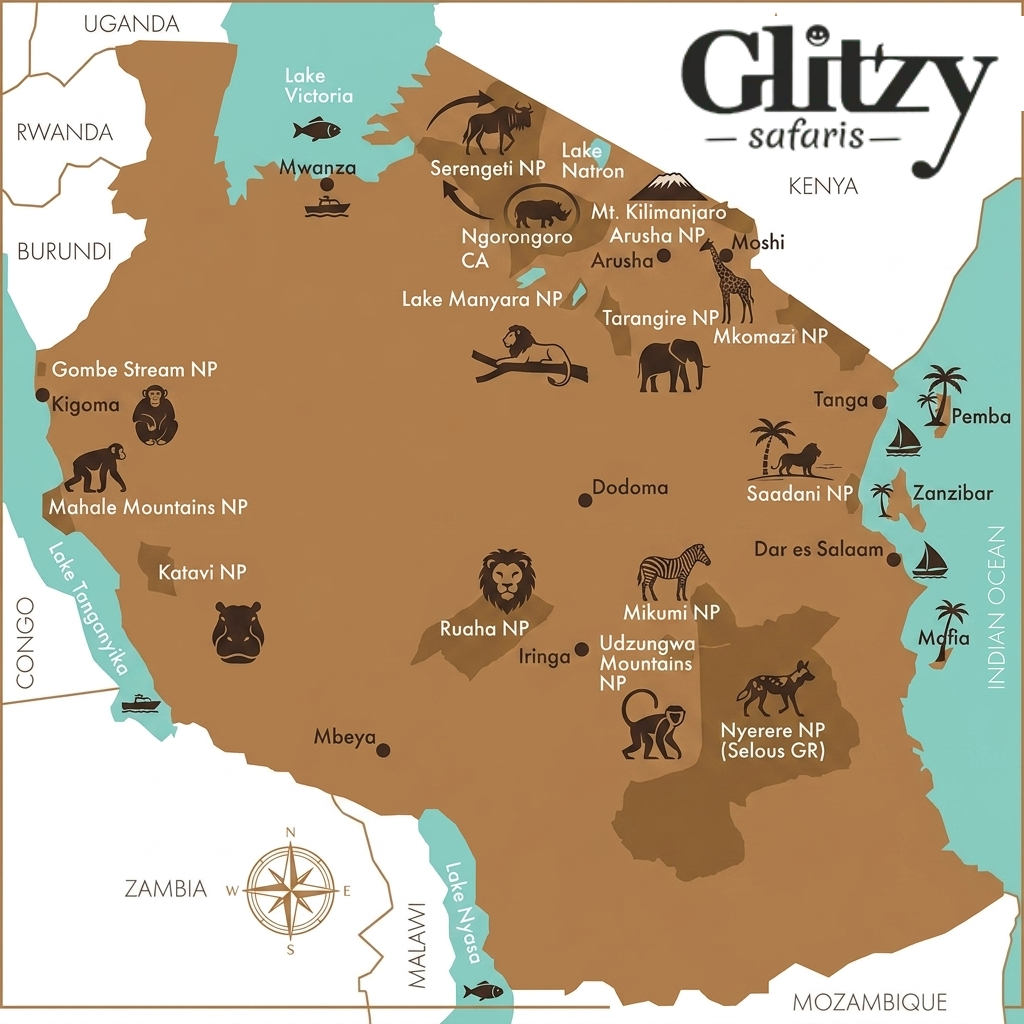
How Tanzania’s Regions Break Down
Most operators, including us, group the country’s attractions into four distinct regions, because each one has its own logic, travel time, and reason to visit.
Northern Tanzania is where almost every first-time safari starts. It holds the headline names — Serengeti, Ngorongoro Crater, Lake Manyara, Tarangire — plus Mount Kilimanjaro standing over all of it. If you’ve seen a Tanzania safari photo in a magazine, it was almost certainly taken here.
The Coast & Islands trade savannah for the Indian Ocean. Zanzibar anchors this region, with Mafia and Pemba islands offering a quieter, more diving-focused alternative for travellers who want water instead of a second game drive.
Southern Tanzania is wilder and far less visited. Nyerere National Park and Ruaha National Park dominate here, both known for raw landscapes, strong predator populations, and a level of solitude the Northern Circuit simply can’t offer anymore.
Western Tanzania is the country’s true frontier — remote, rugged, and built around Katavi’s wide-open plains and the Mahale Mountains, one of the best places anywhere in Africa to see wild chimpanzees.
Each region serves a different kind of traveller. The Northern Tanzania safari circuit suits first-timers who want maximum wildlife in minimum time. A Southern Tanzania safari suits people who’ve already done the Northern Circuit and want fewer vehicles at every sighting. Western Tanzania wildlife experiences suit travellers chasing something genuinely rare. And the islands suit anyone who wants the trip to end on a beach rather than a dirt road.
Where you go depends entirely on what you want to see and when you’re travelling — for the full breakdown of timing, our Tanzania Safari Guide covers that in depth. For now, here are the eleven destinations that make up these four regions, and what each one actually delivers.
1. Serengeti National Park: Tanzania's Ultimate Safari Destination
The Serengeti is the reason most people start looking at Tanzania destinations in the first place. It’s the crown jewel of the Northern Tanzania safari circuit, and the centerpiece of the Great Wildebeest Migration, broadly visible across the park from January through September as over a million animals move through in search of grazing.
What separates the Serengeti from a lot of famous parks is that the migration isn’t the only reason to go. The open plains hold predators and grazing herds year-round, and the park’s well-established network of lodges and camps means it works for almost any travel style — first safari or fifteenth.
2. Ngorongoro Crater: A Natural Sanctuary for the Big Five
Picture a volcanic caldera roughly 20 kilometers across, holding an estimated 30,000 animals within walls steep enough that most of them never leave. That’s the Ngorongoro Crater, and it’s arguably the single most reliable Big Five destination in East Africa.
This UNESCO World Heritage Site packs forests, wetlands, and open plains into one contained ecosystem, which is exactly why sightings here are so consistent compared to searching a vast, open park. Lodges perched along the crater rim look straight down into it — a view that alone justifies the stop on most Northern Tanzania safari circuit itineraries.
3. Tarangire National Park: A Land of Giants
Tarangire sits close to both Lake Manyara and Ngorongoro Crater, and it comes alive during the dry season between June and October, when massive elephant herds gather along the Tarangire River alongside buffalo, giraffe, and zebra.
Beyond the elephants — and this is genuinely one of Tanzania’s largest populations — the park is a serious destination for birdwatchers, with over 500 recorded species. The landscape itself shifts between swampy wetlands, riverine forest, and open woodland dotted with centuries-old baobab trees, giving Tarangire a visual character that’s distinct from anywhere else in the north.
4. Lake Manyara National Park: Where Lions Climb and Birds Soar
Lake Manyara is compact compared to its Northern Circuit neighbours, but it punches well above its size. The park is best known for tree-climbing lions — a genuinely unusual behaviour rarely documented elsewhere in Africa — alongside reliable sightings of elephant, giraffe, buffalo, hippo, and the occasional elusive leopard.
The lake itself draws large flocks of flamingos and pelicans, making this one of the better birdwatching stops on any Tanzania destinations itinerary. Between the open floodplains, dense woodland, and lush evergreen forest, Manyara offers more landscape variety than its modest size suggests.
5. Zanzibar and Tanzania's Islands: An Indian Ocean Escape
Most Tanzania safaris end here. Zanzibar, the country’s enchanting Spice Island, anchors the Coast & Islands region and gives travellers white-sand beaches, turquoise water, and a cultural depth that goes well beyond the postcard image — Stone Town’s winding, spice-scented alleys carry centuries of trading history.
Beyond Zanzibar itself, the Tanzania islands extend the experience further. Pemba, Mafia, and Chole offer pristine beaches, world-class diving, and intimate boutique lodges for travellers who want even more seclusion. A Zanzibar and Tanzania islands stay is now one of the most-booked closing chapters for safaris in this country, particularly among honeymooners and families looking to unwind after a week on the road.
6. Ruaha National Park: Tanzania's Untamed Wilderness
Ruaha is Tanzania’s largest national park, and one of its best-kept secrets. As the centerpiece of any Southern Tanzania safari, it offers a genuinely off-the-beaten-path experience — minimal tourist traffic, very few camps, and wildlife encounters that feel earned rather than crowded.
The park holds large herds of elephant, buffalo, giraffe, kudu, sable, and roan antelope, alongside strong predator populations including lion, cheetah, leopard, and the rare African wild dog. For travellers who’ve already done the Northern Circuit and want the raw, untouched version of a Tanzania safari, Ruaha is usually the first recommendation.
7. Nyerere National Park: Sanctuary of the Wild Dog
Nyerere, formerly known as Selous Game Reserve, spans an area larger than Switzerland — making it Africa’s largest protected wilderness, and the other major anchor of a Southern Tanzania safari. The Rufiji River runs through its heart, weaving a maze of channels, wetlands, and lakes that support one of East Africa’s richest ecosystems.
Buffalo, hippo, crocodile, and lion roam freely here, and the park is a vital refuge for the endangered African wild dog. What makes Nyerere especially worth the detour is what it allows beyond standard game drives — boat safaris, guided walking tours, and fly-camping, none of which are permitted in the more tightly regulated Northern Circuit parks.
8. Lake Tanganyika: Rainforests and Chimpanzee Treks
Lake Tanganyika is the world’s longest freshwater lake, framed by the towering cliffs of the Great Rift Valley and home to extraordinary biodiversity. Along its shores sit Mahale Mountains and Gombe Stream National Parks — the heart of any Western Tanzania wildlife itinerary.
These two parks trade savannah for tropical rainforest, and the main draw is tracking wild chimpanzees through genuinely remote terrain. It’s a different kind of physical effort than a game drive, and a different kind of reward — this region rarely makes a first-time itinerary, but it’s consistently one of the most memorable additions for travellers building a second or third trip to Tanzania.
9. Mount Kilimanjaro: Africa's Majestic Summit
Standing at 5,895 meters, Mount Kilimanjaro is Africa’s highest peak and the tallest free-standing mountain on Earth — and it’s visible from much of Northern Tanzania, even if you never set foot on its slopes.
For travellers who want to climb it, the good news is that Kilimanjaro is more accessible than most expect, particularly during the dry climbing windows from July to October and January to March, when no technical climbing skills are required. That said, reaching the summit still demands serious preparation and the right itinerary length to acclimatize properly — this isn’t a casual add-on, even in the best season.
10. Arusha: The Safari Gateway
Arusha functions as Tanzania’s safari capital, and for most travellers heading into the Northern Tanzania safari circuit, it’s the first stop. Sitting at the foot of Mount Meru, the city offers easy access via Kilimanjaro International Airport, plus the smaller Arusha Airport for charter flights into more remote parks.
Beyond logistics, Arusha is worth a stop in its own right — local markets, a genuine cultural scene, and a glimpse of Tanzanian daily life that’s easy to miss when you fly straight from the airport to a lodge.
11. Dar es Salaam: Gateway to the Islands and Beyond
Dar es Salaam is best known as a transit point toward Zanzibar and the Indian Ocean coast, but it’s worth more than a layover. The city also provides convenient access to some of Tanzania’s lesser-known wildlife reserves, including the vast Nyerere National Park.
With a strong range of accommodation options, Dar es Salaam works well as a comfortable stop to rest before continuing on to the islands or back into the bush.