
Picture lions stretched beneath an acacia tree, a wall of wildebeest thundering across open grassland, and the Indian Ocean glittering at the end of it all. That’s what a Tanzania safari from UK delivers — and it’s why thousands of British travellers book one every year.
Tanzania doesn’t feel staged or crowded. Instead, you get vast wilderness, genuine wildlife encounters, and landscapes that still look untouched. From the endless Serengeti plains to the Ngorongoro Crater and Zanzibar’s white-sand beaches, this country pairs raw adventure with real relaxation.
So, what do UK travellers actually need to know before booking? This guide breaks down flights, costs, visas, timing, and itinerary options — everything you need to plan your trip with confidence.
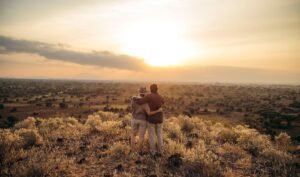
Tanzania sits at the top of most safari shortlists, and the reason is simple: its parks form one connected ecosystem with one of the highest wildlife concentrations on the continent.
The Serengeti anchors that ecosystem. Each year, over two million wildebeest, zebras, and gazelles move across it during the Great Migration — widely considered nature’s most dramatic wildlife event.
Nearby, the Ngorongoro Crater offers something different. This UNESCO World Heritage Site packs the Big Five into a compact volcanic caldera, so sightings come thick and fast.
Beyond game drives, you can also:
Few destinations balance adventure and comfort as well as Tanzania does.
There’s no direct UK-to-Tanzania flight yet, but connections are straightforward. Most British travellers fly out of Heathrow, Gatwick, Manchester, Birmingham, or Edinburgh, then connect through Doha, Amsterdam, Istanbul, Addis Ababa, or Nairobi.
For Northern Circuit safaris, you’ll land at Kilimanjaro International Airport (JRO), positioned between Arusha and Moshi. It’s the main gateway to the Serengeti, Ngorongoro Crater, Tarangire, and Lake Manyara.
Total travel time runs 11–16 hours depending on your route. Long, yes — but the first elephant sighting tends to make that journey feel irrelevant.
Pricing depends heavily on travel style and season. Part of what you’re paying for, though, is conservation: Tanzania’s park fees fund the protection of these ecosystems directly.
Here’s a realistic breakdown, excluding international flights:
If you want personalization without the ultra-luxury price tag, a private mid-range safari typically offers the best value.
Tanzania works as a year-round destination, but what you want to see should drive your timing.
June–October (dry season): Animals cluster around rivers and waterholes as vegetation thins out, making this peak safari season — and the easiest time to spot wildlife.
January–March (calving season): The southern Serengeti fills with newborn wildebeest, which in turn draws lions, cheetahs, and hyenas. Dramatic, fast-paced viewing.
March–May (green season): Often skipped, yet this is when prices drop, crowds thin, and the landscape turns lush after the rains — ideal for photographers.
Explore our Tanzania safari month by month guide, from Tanzania Safari in January to Tanzania Safari in December, to compare wildlife, weather, and the best travel seasons.
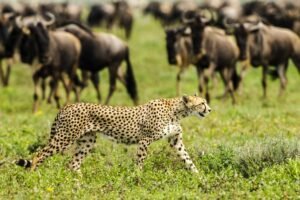
Tanzania’s flagship park and one of the world’s great wildlife ecosystems. Expect lions, leopards, cheetahs, elephants, buffalo, wildebeest, zebras, and giraffes — with the Great Migration as the headline act, though sightings stay strong year-round.
Formed by a collapsed volcano, the crater concentrates an extraordinary range of wildlife into one compact bowl. Many travellers rank a single day here as the highlight of their entire trip.
Quieter than the Serengeti but no less rewarding. Tarangire is known for giant baobab trees and some of Tanzania’s largest elephant herds — with far fewer vehicles around you.
Smaller in size but rich in variety, Lake Manyara offers diverse habitats, strong birdlife, and the rare chance to spot tree-climbing lions. A great park to start your safari with.
British passport holders need a visa to enter Tanzania. Most apply in advance through the Tanzania eVisa system.
Before you travel, double-check that your passport:
Requirements can shift, so it’s worth confirming the latest rules shortly before departure.
This is where Tanzania pulls ahead of other safari destinations: after days in the bush, you can fly straight to Zanzibar and trade dust for ocean.
Expect:
The safari-and-Zanzibar combination remains the most-booked itinerary for couples and families travelling from the UK.
A Tanzania safari from UK isn’t just a holiday — it’s the kind of trip you keep replaying in your head years later. Whether you’re watching sunrise over the Serengeti, tracking elephants in Tarangire, or standing on the crater rim, Tanzania delivers memories that are hard to match.
For UK travellers chasing an authentic African adventure, few destinations compete with what Tanzania offers.